
Integrals over a Curve, Multidimensional Integrals
We will look at two examples of path integrals of vector functions of position and examine their path dependence. The first integral has a non-zero curl (and so we know that it is not the gradient of some scalar potential)
Here is a vector function (xyz, xyz, xyz) for which the curl does not vanish anywhere


These are the conditions that the curl is zero:

There is only one point where this occurs:

Let's evaluate the integral of the vector potential ( ∮ ![Overscript[v, →]](HTMLFiles/Lecture-14_10.gif) •d
•d![Overscript[s, →]](HTMLFiles/Lecture-14_11.gif) ) for any curve that wraps around a cylinder of radius R with an axis that coincides with the z-axis
) for any curve that wraps around a cylinder of radius R with an axis that coincides with the z-axis![[Graphics:HTMLFiles/Lecture-14_12.gif]](HTMLFiles/Lecture-14_12.gif)
Any curve that wraps around the cylinder can be parameritized as (x(t), y(t), z(t)) = (R cos(t), R sin(t), A  (t)) where
  (t) =
(t) =  (t + 2π) and in particular
  (0) =
(0) =  (2π).
(2π).
Therefore d![Overscript[s, →]](HTMLFiles/Lecture-14_18.gif) = (-R sin(t), R cos(t),
= (-R sin(t), R cos(t),  (t)) dt = (-y(t), x(t), A
  (t)) dt
The integrand for an integral of "VectorFunction" around such a curve is (written in terms of an arbitrary P(t):
![Amp Radius^2 Cos[t] P[t] Sin[t] (Radius (Cos[t] - Sin[t]) + Amp P^′[t])](HTMLFiles/Lecture-14_22.gif)
The integral depends on the choice of P(t)
![PathDepInt = Integrate[vf, {t, 0, 2 Pi}]](HTMLFiles/Lecture-14_23.gif)
![∫_0^(2 π) Amp Radius^2 Cos[t] P[t] Sin[t] (Radius (Cos[t] - Sin[t]) + Amp P^′[t]) t](HTMLFiles/Lecture-14_24.gif)
Let's introduce some specific periodic functions for P. Note how the value of the integral changes as the path changes:



![PathDepInt/.{P[t] →t (t - 2 Pi) , P '[t] →D[t (t - 2 Pi), t]}](HTMLFiles/Lecture-14_29.gif)

However, here is curious result which shows that some special paths can ``accidentally'' have zero integrals : let P(t) = cos(n t),
![pdigen = PathDepInt/.{P[t] →Cos[n t], P '[t] → D[Cos[n t], t]}](HTMLFiles/Lecture-14_31.gif)
![-(Amp Radius^2 (8 (-3 + n^2) Radius Sin[n π]^2 + n (-8 Radius + Amp (-9 + n^2) Cos[2 n π]) Sin[2 n π]))/(4 (9 - 10 n^2 + n^4))](HTMLFiles/Lecture-14_32.gif)
![Simplify[pdigen, n∈ Integers]](HTMLFiles/Lecture-14_33.gif)

![[Graphics:HTMLFiles/Lecture-14_36.gif]](HTMLFiles/Lecture-14_36.gif)

![[Graphics:HTMLFiles/Lecture-14_39.gif]](HTMLFiles/Lecture-14_39.gif)

Try the same thing with a conservative (curl free, or exact) Vector Function:
Start with a scalar potential

Create another vector function that should have a zero curl


![anothervf = AnotherVFunction . {-y, x, D[P[t], t]}/.{x→Radius Cos[t], y→Radius Sin[t], z→P[t]}//Simplify](HTMLFiles/Lecture-14_48.gif)
![1/2 ^(Radius^2 Cos[t] P[t] Sin[t]) Radius^2 (2 Cos[2 t] P[t] + Sin[2 t] P^′[t])](HTMLFiles/Lecture-14_49.gif)
The integral depends doesn't on the choice of P(t)
![PathDepInt = Integrate[anothervf, t]](HTMLFiles/Lecture-14_50.gif)
![^(Radius^2 Cos[t] P[t] Sin[t])](HTMLFiles/Lecture-14_51.gif)


For a last example, suppose the curl vanishes on the cylindrical surface defined above:![[Graphics:HTMLFiles/Lecture-14_54.gif]](HTMLFiles/Lecture-14_54.gif)
Suppose we can find a function that has a non-vanishing curl on this surface



It is easy to see that this is the curl of Stooge, where
![Stooge = {-1/2 Integrate[VanishOnCylinder, y], 1/2 Integrate[VanishOnCylinder, x], 0}](HTMLFiles/Lecture-14_59.gif)

In fact, we could add to Stooge, any vector function that has vanishing curl--there are an infinite number of these
![Simplify[Curl[Stooge, Cartesian[x, y, z]]]](HTMLFiles/Lecture-14_61.gif)

Its integral doesn't care which path around the cylinder it takes, the integrand doesn't depend on P(t)
![WhyIOughta = Stooge . {-y, x, D[P[t], t]}/.{x→Radius Cos[t], y→Radius Sin[t], z→P[t]}//Expand](HTMLFiles/Lecture-14_63.gif)
![-1/2 Radius^4 Cos[t]^2 + 1/6 Radius^4 Cos[t]^4 - 1/2 Radius^4 Sin[t]^2 + Radius^4 Cos[t]^2 Sin[t]^2 + 1/6 Radius^4 Sin[t]^4](HTMLFiles/Lecture-14_64.gif)
![Integrate[WhyIOughta, {t, 0, 2 Pi}]](HTMLFiles/Lecture-14_65.gif)
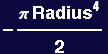
Multidimensional Integral over Irregular Domains
We will attempt to model the energy of ion just above one half of a triangular capacitor. Suppose there is a uniformly charged surface (σ≡charge/area=1) occupying an equilaterial triangle in the z=0 plane:
![[Graphics:HTMLFiles/Lecture-14_67.gif]](HTMLFiles/Lecture-14_67.gif)
what is the energy (voltage) of a unit positive charge located at (x,y,z)
The electrical potential goes like  , therefore the potential of a unit charge located at (x,y,z) from a small surface patch at (ξ,η,0) is
  =
= 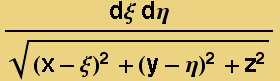
Therefore it remains to integrate this function over the domain η∈(0, ) and ξ∈ (
 -
-  ) , (
) , ( -
- ))
)) 

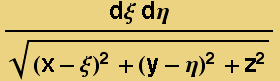 dξdη
dξdη
Mathematica integrates over the last iterator first:
We will try to find the potential due to a triangular patch on a particle located at (x,y,z=1)


Trying to do this directly either takes too long or there is no closed form! We have to work around it by using Indefinite Integrals
![TrianglePotentialNumeric[1, 3, .01]](HTMLFiles/Lecture-14_91.gif)

![Plot[TrianglePotentialNumeric[x, x, 1/40], {x, -1, 1}]](HTMLFiles/Lecture-14_93.gif)


![[Graphics:HTMLFiles/Lecture-14_96.gif]](HTMLFiles/Lecture-14_96.gif)

![[Graphics:HTMLFiles/Lecture-14_119.gif]](HTMLFiles/Lecture-14_119.gif)

The plot above is for a relatively small height z = 1/20 so the contours reveal the triangular shape of the plate at z = 0.
Now look at a somewhat larger value of z = 1/2. The plot below shows contours that are very nearly circular, indicating that the plate is behaving approximately like an equivalent point charge;
| Created by Mathematica (October 18, 2005) |  |

![CurlVectorFunction = Simplify[Curl[VectorFunction, Cartesian[x, y, z]]]](HTMLFiles/Lecture-14_3.gif)
![ConditionsOfZeroCurl = Table[0 == CurlVectorFunction[[i]], {i, 3}]](HTMLFiles/Lecture-14_6.gif)
![FindInstance[ConditionsOfZeroCurl, {x, y, z}]](HTMLFiles/Lecture-14_8.gif)
![vf = VectorFunction . {-y, x, Amp D[P[t], t]}/.{x→Radius Cos[t], y→Radius Sin[t], z→Amp P[t]}//Simplify](HTMLFiles/Lecture-14_21.gif)

![thecurves = ParametricPlot3D[{{Cos[t], Sin[t], Cos[3 t]}, {Cos[t], Sin[t], Cos[ t]}}, {t, 0, 2 Pi}]](HTMLFiles/Lecture-14_35.gif)
![Show[{Graphics3D[Thickness[0.01]], Graphics3D[Hue[0.25, 0.5, 0.5]], thecurves}]](HTMLFiles/Lecture-14_38.gif)
![temp = Grad[Exp[x y z], Cartesian[x, y, z]]](HTMLFiles/Lecture-14_42.gif)

![Simplify[Curl[AnotherVFunction, Cartesian[x, y, z]]]](HTMLFiles/Lecture-14_45.gif)

![TrianglePotentialNumeric[x_, y_, z_] := NIntegrate[1/((x - ξ)^2 + (y - η)^2 + z^2)^(1/2), {η, 0, 3^(1/2)/2}, {ξ, η/3^(1/2) - 1/2, 1/2 - η/3^(1/2) }]](HTMLFiles/Lecture-14_90.gif)
