Exercise 7.1
Recall from Problem 6.2, that the bulk modulus,
 , is a material property that relates the change in
volume with a change in pressure.
, is a material property that relates the change in
volume with a change in pressure.

| Thermodynamics of Materials |
| 3.00 Fall 2001 |
| W. Craig Carter |
| Department of Materials Science and Engineering |
| Massachusetts Institute of Technology |
| 77 Massachusetts Ave. |
| Cambridge, MA 02139 |
Exercise 7.1
Recall from Problem 6.2, that the bulk modulus, , is a material property that relates the change in
volume with a change in pressure.


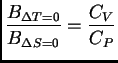
Show that
is related to the ``adiabatic bulk modulus,''
 , where

Exercise 7.2
Also recall from Problem 6.2 that, for a polymer with isothermal bulk modulus
of 0.14 GPa and a density of 0.93 relative to water, there was a critical
ocean depth where the work rate to sink (or float) that material switches from positive
to negative.
Show that the critical depth is an unstable equilibrium.