
MASSACHUSETTS INSTITUTE OF TECHNOLOGY
| Thermodynamics of Materials |
| 3.00 Fall 2001 |
| W. Craig Carter |
| Department of Materials Science and Engineering |
| Massachusetts Institute of Technology |
| 77 Massachusetts Ave. |
| Cambridge, MA 02139 |
Problem Set 5: Due Fri. Oct. 26, Before 5PM in 4-047
Exercise 5.1
Consider heating a body  ,
of constant heat capacity
,
of constant heat capacity  J/
J/ C
and initially at temperature 100K,
to a final temperature of 200K.
The heating takes place by sequentially
placing it in thermal contact with
C
and initially at temperature 100K,
to a final temperature of 200K.
The heating takes place by sequentially
placing it in thermal contact with
 different large thermal reservoirs
(so large that there temperature does
not change during thermal contact).
different large thermal reservoirs
(so large that there temperature does
not change during thermal contact).
For example,
- =1
- The body is placed in contact with a single
reservoir at 200K.
- =2
- The body first attains
thermal equilibrium with a one reservoir at
 =150K;
subsequently, it attains thermal equilibrium with
the second at =200K.
=150K;
subsequently, it attains thermal equilibrium with
the second at =200K.

- The body first attains
thermal equilibrium with a one reservoir at
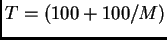 K.
Next, it attains equilibrium with a reservoir at
K.
Next, it attains equilibrium with a reservoir at
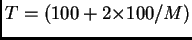 K.
K.
 .
Next, it attains equilibrium with a reservoir at
.
Next, it attains equilibrium with a reservoir at
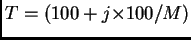 K.
.
Finally, attains equilibrium with a reservoir at
K.
.
Finally, attains equilibrium with a reservoir at
 K.
K.
On the same graph, plot the change in (1) entropy of the
body and (2) the change in entropy of the universe as
a function of  .
.
Exercise 5.2
Consider the phase transformation of pure carbon graphite to pure carbon
diamond at atmospheric pressure and at temperatures between 298 and 1200K.
Using the data:
| graphite |
Standard molar enthalpy |
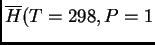 atm atm |
| graphite |
Molar entropy |
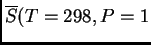 atm atm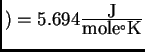 |
| graphite |
Molar heat capacity |
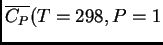 atm atm |
| |
|
|
| diamond |
Standard molar enthalpy |
atm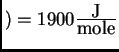 |
| diamond |
Molar entropy |
atm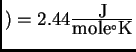 |
| diamond |
Molar heat capacity |
atm |
- Draw an accurate plot of the molar change in molar enthalpy for graphite transforming to diamond
at 1 atm pressure for temperatures between 298 and 1200K.
- Draw an accurate plot of the molar change in Gibb's free energy for graphite transforming to diamond
at 1 atm pressure for temperatures between 298 and 1200K.
- Draw an accurate plot of each of the molar free energies for diamond and for graphite as a function of the entropy of the system
at 1 atm pressure for temperatures between 298 and 1200K.
Exercise 5.3
A quantity of super-cooled liquid Mn at 800K is adiabatically solidified into its equilibrium solid phase at constant
pressure.
From the data below, calculate what fraction of the Mn will have solidified and the final temperature of the
system.
Transition (phase 1
 phase 2) phase 2) |
 ( (
 ) ) |
 (K) (K) |
 |
2010 |
993 |
 |
2300 |
1373 |
 |
1800 |
1409 |
 liquid liquid |
13400 |
1517 |
| phase of Mn |
 ( (
 ) ) |
temperature range (K) |
 |
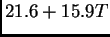 |
298-993 |
 |
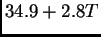 |
993-1373 |
 |
 |
1373-1409 |
 |
 |
1409-1517 |
|
liquid |
 |
1517- |
W. Craig Carter
2001-10-19