


| Thermodynamics of Materials |
| 3.00 Fall 2001 |
| W. Craig Carter |
| Department of Materials Science and Engineering |
| Massachusetts Institute of Technology |
| 77 Massachusetts Ave. |
| Cambridge, MA 02139 |
Exercise 3.1
 m
m ) that contains
an ideal diatomic gas (
) that contains
an ideal diatomic gas (
 )
initially at 1 atm.
)
initially at 1 atm.
Calculate the minimum amount of work that must be passed into the room to
heat it from 10 C to 25C.
m) that contains
an ideal diatomic gas (
)
initially at 1 atm.
Calculate the minimum amount of work that must be passed into the room to
heat it from 10C to 25C.
Exercise 3.2
![$ [100]$](img5.gif) ,
, ![$ [010]$](img6.gif) , and
, and ![$ [001]$](img7.gif) are parallel to
the
are parallel to
the  -,
-,  -, and
  -axes has an anisotropic stiffness tensor,
 (
(
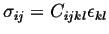 ) with components given by:

If such a thin film of single crystal silicon is afixed to a flat substrate (the plane
of the substrate being - and the normal to the substrate is parallel to the -axis)
the film will have the following strain state:
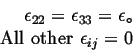
Calculate an expression for the internal energy density as stored by the elasticity.
 J
J m
m , find an
expression that predicts
the thickness of the film that will delaminate.
, find an
expression that predicts
the thickness of the film that will delaminate.
![$ [110]$](img18.gif) -oriented thin film
(, , and are parallel to ,
-oriented thin film
(, , and are parallel to ,
![$ [1\overline{1}0]$](img19.gif) , and ).
Because the stiffness is a tensor, the components must be transformed into a
the coordinate system associated with the substrate coordinates.
The transformed stiffness for a -orientation is:
, and ).
Because the stiffness is a tensor, the components must be transformed into a
the coordinate system associated with the substrate coordinates.
The transformed stiffness for a -orientation is:
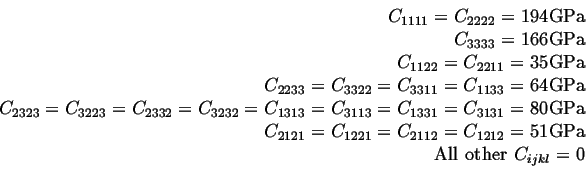
The state of strain is independent of the orientation.
![$ h_{[100]}/h_{[110]}$](img21.gif) at which
a thin film would delaminate.
at which
a thin film would delaminate.