


| Thermodynamics of Materials |
| 3.00 Fall 2000 |
| W. Craig Carter |
| Department of Materials Science and Engineering |
| Massachusetts Institute of Technology |
| 77 Massachusetts Ave. |
| Cambridge, MA 02139 |
Exercise 6.1
Show that the following relationships are true:
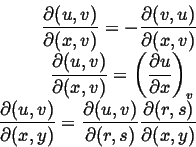 |
(1) |
Write out all the Maxwell relations that do not involve changes
in composition (i.e., the four that involve  ,
,  ,
,  ,
,  )
in terms of Jacobians.
)
in terms of Jacobians.
Exercise 6.2
A reaction vessel that can be held at constant pressure and
temperature initially has one mole of
SO ,
one mole of
H, and one mole of
CO
,
one mole of
H, and one mole of
CO .
.
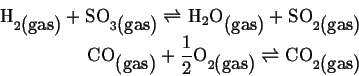
The system can react as follows:
 |
(2) |
Show how you can solve for the equilibrium concentrations. You will need to write a number of explicit equations in terms of an equal number of variables. Don't attempt to solve the problem, just set it up as clearly as possible.
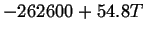
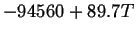
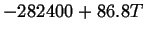
| Molar Gibbs Free Energy Changes for Gaseous Reactions | ||
| Reaction |
 (Joules/mole) (Joules/mole) |
Temperature range (Kelvin) |
H |
 |
298-2500 |
SO |
 |
318-1800 |
CO |
 |
298-2500 |
Exercise 6.3
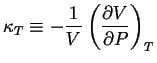
The isothermal compressibility,  , is defined as:
 |
(3) |
State in a clear sentence what the quantity physically
represents. Calculate as a function of  , , and for
an ideal gas. Identify two other materials that would have a differing
value of and describe why those values differ.
, , and for
an ideal gas. Identify two other materials that would have a differing
value of and describe why those values differ.
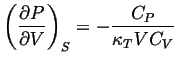
Show that
 |
(4) |
Exercise 6.4
Determine the slope and curvature of
 constant
 .
.
Write down the Taylor series of
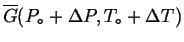 to second order in
  and
and  ,
and where possible relate the
coefficients to physical quantities.
,
and where possible relate the
coefficients to physical quantities.