


| Thermodynamics of Materials |
| 3.00 Fall 2000 |
| W. Craig Carter |
| Department of Materials Science and Engineering |
| Massachusetts Institute of Technology |
| 77 Massachusetts Ave. |
| Cambridge, MA 02139 |
Exercise 5.1
(Be careful, this question is a little tricky.)
Calculate the minimum number of joules per cubic meter
required to heat a room of ideal monatomic gas from 10 C
to 20
C
to 20 C at constant atmospheric pressure.
Exercise 5.2
Consider heating a body  ,
of constant heat capacity
,
of constant heat capacity  J/C
and initially at temperature 100K,
to a final temperature of 200K.
The heating takes place by sequentially
placing it in thermal contact with
J/C
and initially at temperature 100K,
to a final temperature of 200K.
The heating takes place by sequentially
placing it in thermal contact with
 different large thermal reservoirs
(so large that there temperature does
not change during thermal contact).
different large thermal reservoirs
(so large that there temperature does
not change during thermal contact).
For example,
=1 is placed in contact with a single
reservoir at 200K.
=2 first attains
thermal equilibrium with a one reservoir at  =150K;
subsequently, it attains thermal equilibrium with
the second at =200K.
=150K;
subsequently, it attains thermal equilibrium with
the second at =200K.
 first attains
thermal equilibrium with a one reservoir at
first attains
thermal equilibrium with a one reservoir at
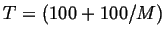 K.
Next, it attains equilibrium with a reservoir at
K.
Next, it attains equilibrium with a reservoir at
 K.
K.
 .
Next, it attains equilibrium with a reservoir at
.
Next, it attains equilibrium with a reservoir at
 K.
.
Finally, attains equilibrium with a reservoir at
K.
.
Finally, attains equilibrium with a reservoir at
 K.
K.
On the same graph, plot the change in (1) entropy of the
body and (2) the change in entropy of the universe as
a function of  .
.
Exercise 5.3
Consider a closed system of 1 microgram of solid lead initially
at 273K and constant atmospheric pressure.
The system receives heat isochorically and isobarically
at a rate of 1 millicalorie per decifortnight from a gigagiant
thermal reservoir at 2000K.
Lead melts at 327.502C and boils at 1740C.
The molar latent heat of melting for lead at 1 atm is
4.81 kilojoules.
Use as a standard reference state for entropy and enthalpy,
 and
and
 .
.
| Heat capacity of Pb at constant 1 atm pressure | ||
| Phase | Molar Heat Capacity | Temperature range |
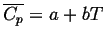 , is kelvin , is kelvin |
(Kelvin) | |
| Solid |
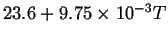 |
298-600 |
| Liquid |
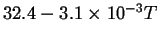 |
600-2013 |
Exercise 5.4
Write a Haiku poem about the second law of thermodynamics.
Haiku is a three line poem, the first and third line each have
five and the second line has seven syllables.
Haiku quality is judged not only by beauty and subtlety of
expression but also on the density of meaning and content.
If you wish your Haiku to be added to the incipient website:
http://pruffle.mit.edu/3.00/Literature_of_Thermodynamics/.
Please email it to me (ccarter@mit.edu) and it will be included in the
public collection and attributed to you.