


| Thermodynamics of Materials |
| 3.00 Fall 2000 |
| W. Craig Carter |
| Department of Materials Science and Engineering |
| Massachusetts Institute of Technology |
| 77 Massachusetts Ave. |
| Cambridge, MA 02139 |
Exercise 3.1
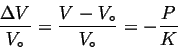
The bulk modulus,  , of an isotropic linear elastic solid
is defined by the dialation,
, of an isotropic linear elastic solid
is defined by the dialation,
 ,
response to hydrostatic pressure
,
response to hydrostatic pressure  :
:
 |
(1) |
Typical values of for an ionic crystal are about  GPa.
(GPa = 1 Gigapascal, 1 atm
GPa.
(GPa = 1 Gigapascal, 1 atm
 MPa)
MPa)
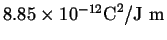
The permittivity of vacuum,
 is
is
 .
Typical values of the dielectric susceptibility,
.
Typical values of the dielectric susceptibility,
 (
(
 ), of an ionic crystal
are about 50 (unitless).
), of an ionic crystal
are about 50 (unitless).
The permittivity of vacuum,
 , is
, is
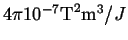 (T is a tesla).
The magnetic susceptibility,
(T is a tesla).
The magnetic susceptibility,
 (
(
 ), of a typical
paramagnetic ionic crystal is about 10 (unitless).
), of a typical
paramagnetic ionic crystal is about 10 (unitless).
Calculate all the ratios of: stored elastic energy, stored polarization energy, and stored magnetic energy in a typical ionic crystal at 1 atm, 220 volts/m, and in the earth's magnetic field.