


| Thermodynamics of Materials |
| 3.00 Fall 2000 |
| W. Craig Carter |
| Department of Materials Science and Engineering |
| Massachusetts Institute of Technology |
| 77 Massachusetts Ave. |
| Cambridge, MA 02139 |
Exercise 2.1
Please do problem two of chapter two of Fermi.
Exercise 2.2
Estimate the difference in temperature of water just at
the top of Niagra Falls and that just at the bottom.
Exercise 2.3
A closed system is composed of a body of lead and a body of aluminum connected by a wire of
gold. The lead sphere has a radius of 0.5 m while the aluminum sphere has a
radius of 1 m. The lead body is initially at  C and the
aluminum body is initially at
C and the
aluminum body is initially at  C. The dimensions of the gold
wire are 0.1 mm in radius by 10 cm in length at its initial
temperature of
C. The dimensions of the gold
wire are 0.1 mm in radius by 10 cm in length at its initial
temperature of  C.
C.
Calculate the change in energy of the lead and of the aluminum after the adiabatic system comes to thermal equilibrium. You may ignore the effects of thermal expansion. State any other assumptions that you employ.
| Heat capacities at constant pressure | ||||
| Molar Heat Capacity | Temperature range | density at C |
Coefficient of | |
| Material | (joules/(degree mole)) | of validity(C) | (g/cm ) ) |
Thermal Expansion |
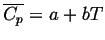 , ,  is kelvin is kelvin |
(meter/(meter  C)) C)) |
|||
| Lead |
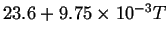 |
 to to  C C |
 |
 |
| Aluminum |
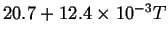 |
to  C C |
 |
 |
| Gold |
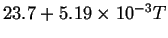 |
to  C C |
 |
 |