


| Thermodynamics of Materials |
| 3.00 Fall 2002 |
| W. Craig Carter |
| Department of Materials Science and Engineering |
| Massachusetts Institute of Technology |
| 77 Massachusetts Ave. |
| Cambridge, MA 02139 |
Exercise 8.1
Demonstrate that Poisson's ratio,  ,
cannot exceed
,
cannot exceed
 by finding particular value of
strain
by finding particular value of
strain
 (for an isotropic material with
elastic Young's modulus
(for an isotropic material with
elastic Young's modulus
 ) that makes the
stored elastic strain energy negative.
) that makes the
stored elastic strain energy negative.
Exercise 8.2
Starting with the Gibbs-Duhem expression for phases with
fixed composition,
derive the Clausius-Clapeyron relation
 .
.
Using a carefully worded sentence or two, describe what this Clausius-Clapeyron means physically.
Exercise 8.3
Consider a binary alloy with components  and
and  , let
, let
 ,
,  ,
and
,
and
 represent the compositions of three phases
  ,
,  , and
, and  that coexist at a triple point at
 and
and
 .
.
Note that, for each phase in a binary alloy, the composition is given by one variable only
because
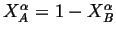 ,
,
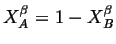 ,
and
,
and
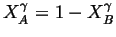 .
.
Starting with the Gibbs-Duhem expression,
derive a relationship for the change in the triple point
 material properties
 .
.
Also for the triple point, find a relationship between the
change in the chemical potential of A ( )
and the change in the chemical potential of B (
)
and the change in the chemical potential of B ( ).
).
Exercise 8.4
In Homework problem 5.2, you found the equilibrium temperature and
length of a thermally expanding in contact with a thermostat.
Using the engineering solution in the solution set, determine whether that stability is locally stable or unstable.