| Thermodynamics of Materials |
| 3.00 Fall 2002 |
| W. Craig Carter |
| Department of Materials Science and Engineering |
| Massachusetts Institute of Technology |
| 77 Massachusetts Ave. |
| Cambridge, MA 02139 |
Exercise 5.1
Pure plutonium forms six different equilibrium solids at atmospheric pressure.
The room temperature equilibrium phase,  , is monoclinic.
Transition (phase 1
 phase 2) phase 2) |
 ( (
 ) ) |
 ( (
 ) ) |
 |
0.8 | 122 |
 |
0.15 | 205 |
 |
0.13 | 318 |
 |
0.02 | 451 |
 liquid liquid |
0.44 | 476 |
The standard enthalpy of formation (i.e., the zero of the enthalpy scale of Pu at STP) is
 K
K atm
atm and the entropy at STP is
 Katm
Katm cal
cal mole.
mole.
The molar heat capacities are given by
| phase of Pu |
 (
calmole) (
calmole) |
temperature range (
 K) K) |
 |
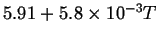 |
298-395 |
 |
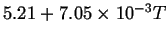 |
395-480 |
 |
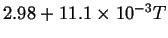 |
480-588 |
|
 |
588-753 |
 |
 |
753-913 |
| liquid |  |
913- |
 K to
K to  K.
K.
K to K.
K to K.
K to K.
-Pu at  K is mixed with liquid Pu at
  K in the ration of 2:1.
What would be the resulting equilibrium phase?
K in the ration of 2:1.
What would be the resulting equilibrium phase?
5% Extra Credit: Find the crystal structures of each of the stable phases.
Exercise 5.2
The coefficient of linear thermal expansion is defined as:
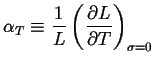
 decreases its length with temperature if
no load (
decreases its length with temperature if
no load (
 ) is applied to the bar--per unit length of the bar.
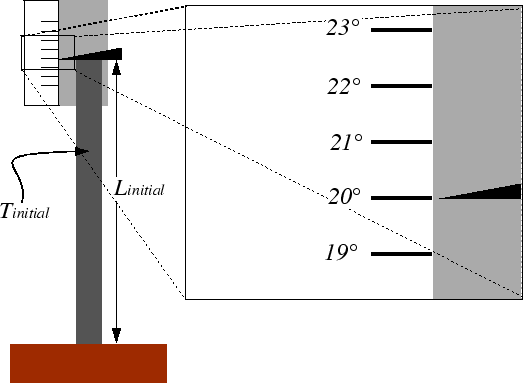
In a diabolical attempt to defeat the thermostat that controls the temperature
along the infinite corridor, you decide to weld a stiff bar of length
 at an initial temperature of
 to the thermostat switch that
controls the temperature along the I.C.
to the thermostat switch that
controls the temperature along the I.C.
is a constant, the I.C. has an initial temperature of 20
, and
the degree marks on the thermostat are separated by 5mm each, find an expression for the
equilibrium temperature of the I.C. as a function of
and
.
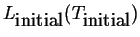 for which the
temperatures are unbounded?
for which the
temperatures are unbounded?
10% Extra Credit: Plot the isotherms of equilibrium temperature in the
-
plane.
Exercise 5.3
In this problem, the entropy change of the universe is be calculated for different ways of bringing
two blocks at different temperatures and composed of the same material to equilibrium.
Assume the initial configuration is 1/2 mole of material at temperature  and 1/2 mole of
material at temperature
and 1/2 mole of
material at temperature  .
The molar heat capacity,
.
The molar heat capacity,  , is constant between and and there are no phase transitions
between and .
, is constant between and and there are no phase transitions
between and .
Calculate the entropy change of the universe (which is composed only of the two blocks which do no work on each other) for the following methods of equilibration:
is placed in contact with one 1/4 mole block at
and a new equilibrium system of 1/2 mole is obtained (some entropy).
and the one remaining 1/4 mole block at are both
placed in contact with the equilibrium composite system that was equilibrated in the previous step (some more entropy).
is brought into equilibrium with one of the 1/8 mole blocks at .
and one of the 1/8 mole blocks at are brought into equilibrium with the
1/4 mole block produced in the previous step.
and one of the 1/8 mole blocks at are brought into equilibrium with the
1/2 mole block produced in the previous step.
and one of the 1/8 mole blocks at are brought into equilibrium with the
3/4 mole block produced in the previous step.
 by equal parts of 1/
 mole.
mole blocks at is brought into equilibrium with one of the 1/ mole blocks at .
mole blocks at and one of the 1/ mole blocks at are brought into equilibrium with the
block produced in the previous step.
mole.
mole blocks at is brought into equilibrium with one of the 1/ mole blocks at .
mole blocks at and one of the 1/ mole blocks at are brought into equilibrium with the
block produced in the previous step.

mole blocks at and one of the 1/ mole blocks at are brought into equilibrium with the
block produced in the previous step.