| Thermodynamics of Materials |
| 3.00 Fall 2002 |
| W. Craig Carter |
| Department of Materials Science and Engineering |
| Massachusetts Institute of Technology |
| 77 Massachusetts Ave. |
| Cambridge, MA 02139 |
Exercise 3.1
 m
m ) that contains
an ideal diatomic gas (
) that contains
an ideal diatomic gas (
 )
initially at 1 atm.
)
initially at 1 atm.
Calculate the minimum amount of work that must be passed into the room to
heat it from 10 C to 25C.
m) that contains
an ideal diatomic gas (
)
initially at 1 atm.
Calculate the minimum amount of work that must be passed into the room to
heat it from 10C to 25C.
Exercise 3.2
There are four state variables for an arbitrary pure gas:
total moles of gas molecules, pressure, volume, and temperature.
How many independent state variables exist for a mole of an ideal gas?
Using different combinations of independent variables, write as many unique (but numerically equivalent) expressions for the molar internal energy of an ideal gas as possible.
Exercise 3.3
Suppose that, in a desperate attempt to lower the temperature in your adiabatically enclosed dorm
room, you prop open the door of your refrigerator.
Your refrigerator operates at 110 volts and draws a constant 30 amperes.
Using the axes below, draw two schematic curves of the temperature in your adiabatically enclosed room as a function of time. For one curve, plot the temperature versus time for the case that the refrigerator door is kept closed; for the other curve, plot the temperature versus time for the case that the refrigerator door is kept open. A schematic plot is one that illustrates relevant physical aspects of the system, but need not be numerically quantitative.
Illustrate or annotate any relevant characteristics of your curves--and be sure to indicate which curve corresponds to each case.
Exercise 3.4
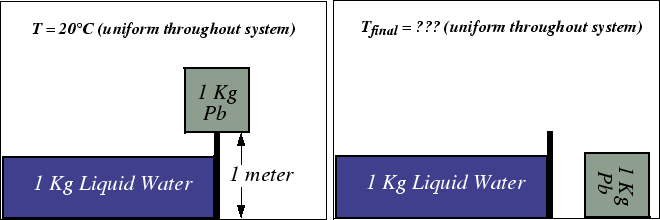
Consider an isolated system consisting of a kilogram of lead and a kilogram of water illustrated
below.
 ; the heat capacity
of 1 kilogram of water is given by
; the heat capacity
of 1 kilogram of water is given by
 ; all other heat capacities
in the isolated system can be neglected.
and
may be considered independent of any constraints (e.g., constant
pressure or constant volume) and to be independent of temperature.
; all other heat capacities
in the isolated system can be neglected.
and
may be considered independent of any constraints (e.g., constant
pressure or constant volume) and to be independent of temperature.