


 has been assumed to be isotropic. Under this
assumption, a finite (isolated) volume body will
reduce its total surface energy to a minimum.
The result for an isolated body for isotropic surface tension is a sphere.
has been assumed to be isotropic. Under this
assumption, a finite (isolated) volume body will
reduce its total surface energy to a minimum.
The result for an isolated body for isotropic surface tension is a sphere.
However, for crystals,
is a function of
the orientation of the surface
 .
For example, in 2-D
.
For example, in 2-D
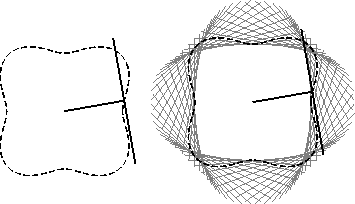 |
The Wulff construction is performed as follows:2
For each orientation
 , draw a ray from
the origin to the surface of
.
At the end of each ray, construct the
perpendicular half plane. The interior of the
envelope that results from all such half planes
is the minimizing shape for a finite isolated
volume.
, draw a ray from
the origin to the surface of
.
At the end of each ray, construct the
perpendicular half plane. The interior of the
envelope that results from all such half planes
is the minimizing shape for a finite isolated
volume.

 of a surface.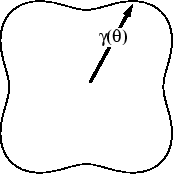
 . The interior envelope in
the right figure is the minimizing shape in two dimensions.
. The interior envelope in
the right figure is the minimizing shape in two dimensions.