


Next: The Shapes of Things
Up: Lecture_35_web
Previous: Fundamental relations for surfaces
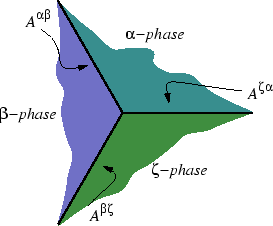
Consider the case where three different phases
make contact:
Figure 35-6:
Intersection, or triple line, where three phases make contact in space.
 |
Considering
must be a minimum, one may derive two relations for the angles of contact:
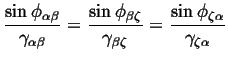 |
(35-27) |
which is the general equation the angles at a triple line, called Young's equation,
where
Figure 35-7:
The definitions of the terms in Young's Equation, Equation 35-27.
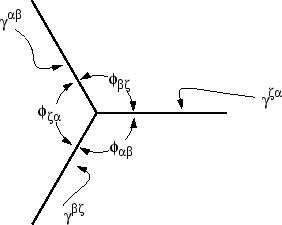 |
which is equivalent to the ``force balance''
where each of the
 are considered the
forces applied to the vertex.
are considered the
forces applied to the vertex.
For the special case in which
one interface is constrained to be flat, as in
Figure 35-8:
o
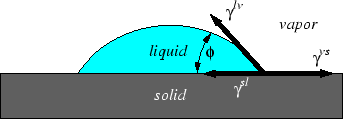 |
One can derive (by force balance most simply)
 |
(35-28) |
(note--the above is two separate equations that appear to be run together: cos phi is the ratio
of a difference over the liquid-vapor surface tension)
which is Young's equation for flat surfaces.
 wetting angle wetting angle 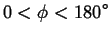 |
(35-29) |
Next: The Shapes of Things
Up: Lecture_35_web
Previous: Fundamental relations for surfaces
W. Craig Carter
2002-12-03
