


Next: The Conditions of Equilibrium
Up: Lecture_35_web
Previous: Curvatures of Simple Surfaces
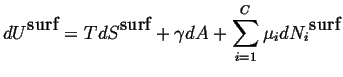
In this section it will be shown that there
are additional
solubility effects associated with interfaces.
Consider:
 |
(35-19) |
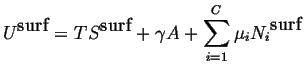
since the dependent variables are all extensive,
we can integrate (i.e. homogeneous degree
 in
all of its variables), therefore
in
all of its variables), therefore
 |
(35-20) |
Taking the derivative (as was done when deriving
the Gibbs-Duhem equation);
 |
(35-21) |
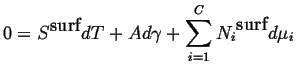
comparing to Equation 35-19,
 |
(35-22) |
which expresses a relation between variations of the intensive
degrees of freedom for a surface to remain in equilibrium.
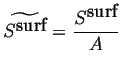
Dividing through by the total surface area (so as to normalize
by the area, creating derived intensive variables) and
defining
 |
(35-23) |
as the entropy of the surface per area, then,
 |
(35-24) |
where
 |
(35-25) |
is the standard notation for the excess surface
concentration.
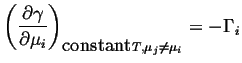
Holding everything (temperature, et cetera)
constant except
 , we get a relation that
expresses the relation between the change in
surface tension to the change in chemical
potential of an absorbing species:
, we get a relation that
expresses the relation between the change in
surface tension to the change in chemical
potential of an absorbing species:
 |
(35-26) |
This is the ``Gibbs Absorption Isotherm.''
Note that if a species absorbs to the surface
 and the surface tension decreases
as the chemical potential of that species is
increased.
and the surface tension decreases
as the chemical potential of that species is
increased.
Next: The Conditions of Equilibrium
Up: Lecture_35_web
Previous: Curvatures of Simple Surfaces
W. Craig Carter
2002-12-03