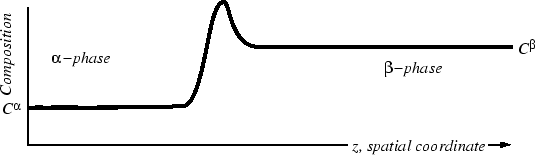
Note the atoms at the surface were treated as being somehow different than those of the bulk. This idea can be extended rigorously to treat the interface as a relatively thin layer. This thin layer will be treated as a separate ``quasi-two-dimensional phase.''
The original Gibbs idea was as follows:
Suppose the composition is different between to phases
(but dictated by
 , of course).
There is
no requirement that the concentration should
be uniform in the vicinity of the interface:
, of course).
There is
no requirement that the concentration should
be uniform in the vicinity of the interface:
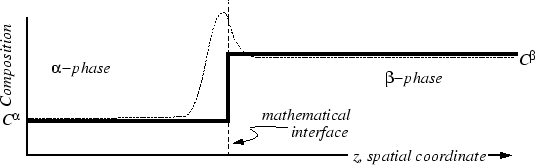
The Gibbs treatment extends each of the homogeneous phases up to a mathematical surface:
Subtract the real system in Figure 35-2 from its idealization in Figure 35-3 to define an excess quantity associated with the mathematical surface ``The Gibbs Surface'' which has no volume associated with it, but excess extensive quantities.
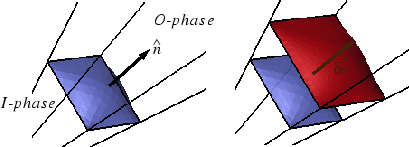
If the following illustration represents a thermodynamic system:
 |
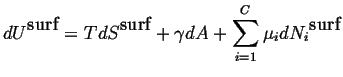
For the surface phase:
 |
(35-7) |
 is the surface area of the interface.
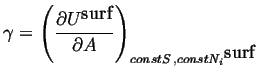
What is
 ?
?
Obviously,
 |
(35-8) |
But, it also represents the work done to increase the surface area
 |
(35-9) |
 is applied to a surface of width
 to
extend its length
to
extend its length
 .
.
This is the surface tension, it has units of force per unit length or, equivalently, surface energy per area. It is the energy associated with creating surface.1
Consider the entire system:
 |
(35-10) |
Because the surface represents an object that can resist pressure, it can no longer assumed that the pressures on the inside and the outside phase are equal.
For equilibrium
 ,
along with the temperature and chemical
potentials being uniform:
,
along with the temperature and chemical
potentials being uniform:
 |
(35-11) |
Imagine that the surface moves normal to itself (such as in Figure 35-4)
Then the following relations hold:
 |
(35-12) |
 |
(35-13) |
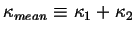
where
 and
and
 are the ``curvatures''
of the surface in each of two perpendicular
planes, where the axis of intersection is
normal to the surface.
are the ``curvatures''
of the surface in each of two perpendicular
planes, where the axis of intersection is
normal to the surface.
 |
(35-14) |
 , and
, and
 where
where
 and
and
 are the
radii of curvature.
are the
radii of curvature.
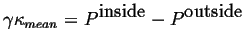
Putting equations 35-12, 35-13, and 35-14 together, the following important relation holds:
 |
(35-15) |
which is known as the Gibbs-Thompson equation. It relates the difference in pressure at an interface to its surface tension and curvature.