


In the treatment of the equilibrium of phases the effect of the surface that separates the various phases was neglected.
In other words, no distinction was made between systems that had an abundance of surface and those that do not--there was no distinction made between:
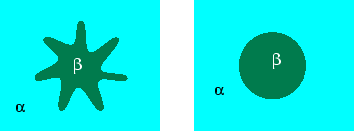 |
Consider, as an example, that an atom on a surface as having a 50% higher energy than those in the bulk, then there will be an extra energy associated with the surface of a sphere.
To estimate how much energy is associated with the surface let:
 surface area of
 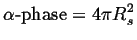 volume of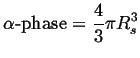
The energy of the system is:
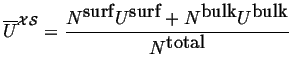 |
(35-1) |
Letting the energy of an atom on the surface be half again that of the bulk:
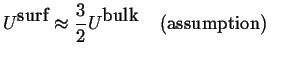 |
(35-2) |
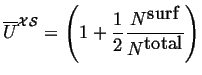 |
(35-3) |
If
 is the volume per atom and
 is the radius of an atom, then
 |
(35-4) |
Letting
 be the radius of the sphere:
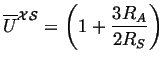 |
(35-5) |
How small does the sphere need to be in order that the excess is about 1%?
 |
(35-6) |
This is pretty small, but important important in many systems.