


Recall how the the internal degrees of freedom were extended to include work terms associated with the transfer of charged particles from one electrostatic potential to another:
 |
(34-8) |
(Note:
 represents the change in the
number of moles of species
represents the change in the
number of moles of species
 if
if
 is
the chemical potential of a mole of species
.
This is done so that the Faraday
constant
is
the chemical potential of a mole of species
.
This is done so that the Faraday
constant
 appears in the equation from the
start-the Faraday constant is the charge on a mole of electrons.)
appears in the equation from the
start-the Faraday constant is the charge on a mole of electrons.)
Equation 34-8 can be rewritten as
 |
(34-9) |
where
 |
(34-10) |
 is called the ``electrochemical potential''.
The conditions for equilibrium are analogous to all other reactions:
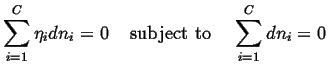 |
(34-11) |
and when, in addition, the system is closed (
 )
)
 |
(34-12) |