


Background:
Consider the maximum work that can be obtained when
1 mole of of hydrogen combines with half a mole of
of oxygen to form water vapor at
 C.
C.
 |
(34-1) |
The entropy of the thermal surroundings of the reaction increase by
 |
(34-2) |
So the total entropy of the universe
increases1 by
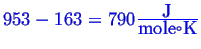
WHAT a WASTE! In order
not to violate the second law, only
only
 amount of heat needs to be transfered.
 |
(34-3) |
 |
(34-4) |
Apparently,
 represents the maximum
work that can be extracted from a system.
represents the maximum
work that can be extracted from a system.
How can this work be extracted? In principle it could be harnessed to drive an electric motor. To do this, a source of electrons is needed and those can be generated those by the reactions:
 |
(34-5) |
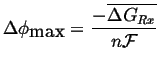
The work done by the electric motor is the potential drop between the source and sink of the electrons, multiplied by the net charge that they carry:
 |
(34-6) |
or
 |
(34-7) |
The maximum potential is related to the molar Gibbs free energy of the reaction.