


Thermodynamic data for the oxidation of a number of common metals can be usefully and graphically codified in an Ellingham Diagram (Gaskell, page 272).
For example:
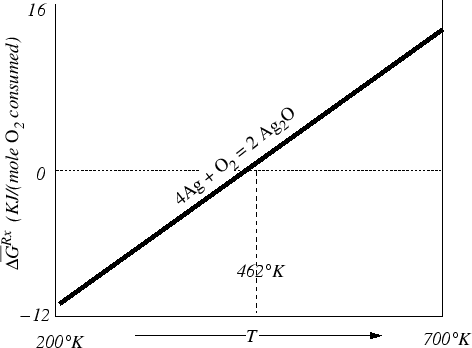 |
It can be observed at a glance that reaction tends to favor the products below 462K; however, the partial pressure of oxygen must also be considered.
Consider the the equilibrium of this reaction as a function of oxygen partial pressure.
 |
(33-25) |
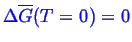
This represents the intersection of two
lines: one is
 that is plotted
and the other is a straight line that
emanates from
that is plotted
and the other is a straight line that
emanates from
 with slope
given by
with slope
given by
 .
To determine
what
.
To determine
what
 will Ag not
oxidize at room temperature.
will Ag not
oxidize at room temperature.
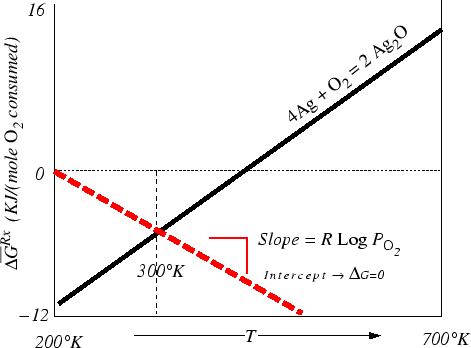 |
For the case of Silver, the reaction is very close to equilibrium at standard temperature and pressure. This explains, in part, why silver develops a slight tarnish.
Richardson and Jeffes had the clever idea of adding a handy scales on the outside of the diagram so that the equilibrium partial pressures for hydrogen/water vapor and the equilibrium partial pressures of carbon monoxide and carbon dioxide can be read analogously to the partial pressure of oxygen. The result is a useful graphical compendium of thermodynamic data for many condensed metal/vapor reactions.
 |
 and the
intersection is
and the
intersection is
 .
. .
Equilibrium is where the curves intersect; at temperatures above the intersection
temperature the metal will oxidize.
.
Equilibrium is where the curves intersect; at temperatures above the intersection
temperature the metal will oxidize.