


Consider the reduction of
SiO to Si by heating it
at
to Si by heating it
at
 atm.
At what temperature will the
reduction take place and what will be the
pressure of CO (gas) if the reaction takes place at
atm.
At what temperature will the
reduction take place and what will be the
pressure of CO (gas) if the reaction takes place at
 C?
C?
The pertinent reaction is
 |
(33-14) |
The following reactions are tabulated:

Notice that:
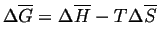 where
where
 and
and
 are
treated as independent of
are
treated as independent of  (This is approximately true if the molar
heat capacities are nearly the same.).
(This is approximately true if the molar
heat capacities are nearly the same.).
 .
.
The reaction of interest can be written as:
 First Reaction
 Second Reaction
 Third Reaction
or
 |
(33-15) |
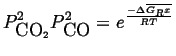
so that
 |
(33-16) |
Since
 at all
 , the reaction will
favor the products.
, the reaction will
favor the products.
The total pressure is given by
 |
(33-17) |
Question: Why is
 included? Because
one can't balance a reaction between carbon monoxide and carbon dioxide without it.
included? Because
one can't balance a reaction between carbon monoxide and carbon dioxide without it.
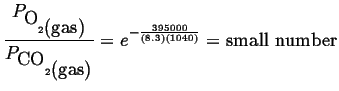
For
 |
(33-18) |
So
 |
(33-19) |
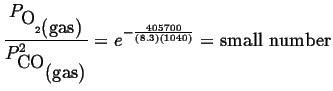
for
 |
(33-20) |
 |
(33-21) |
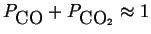
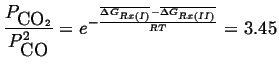
We conclude that
is small compared
to
 and
and

 |
(33-22) |
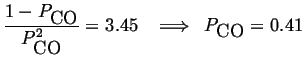
Therefore:
 |
(33-23) |
 |
(33-24) |
Question: Will the fraction of CO go up or down with temperature?