


Consider the general case:
 |
(33-4) |
Assuming the system is closed, the condition for equilibrium is just:
 |
(33-5) |
which becomes, if reference is made to the pure states
 |
(33-6) |
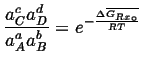
so the condition for equilibrium becomes
 |
(33-7) |
where the activity of a component is
 which is to be determined
empirically.
which is to be determined
empirically.
However, there are standard approximations in which the solid phases in the reaction can be considered to be pure. In this approximation, and through use the additional thermodynamic approximations for material behavior:
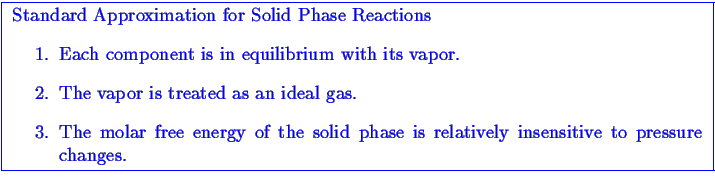
Approximate equilibrium conditions can be obtained by practical means.
Consider the oxidation (or, the reverse, the reduction) of a pure metal:
 |
(33-8) |
The chemical potentials of each each component in each solid phase is in equilibrium with the gaseous phase.
 |
(33-9) |
Therefore, it is appropriate to consider equilibrium in the gas phase.
Considering an ideal gas mixture
 |
(33-10) |
 for typical metals is
 -
-
 atm.
atm.
 for typical oxides is
 -
-
 atm.
Such tiny numbers which would be very, very
difficult to measure.
atm.
Such tiny numbers which would be very, very
difficult to measure.
Also
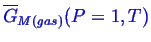 and
and
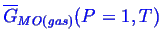 represent
molar free energies that are highly unstable
with respect to forming a solid or a liquid
at sub-solar temperatures.
represent
molar free energies that are highly unstable
with respect to forming a solid or a liquid
at sub-solar temperatures.
Expressions for
 and
and
 can be obtained by integrating the pressures for the
gas phase and the condensed phase:
can be obtained by integrating the pressures for the
gas phase and the condensed phase:
 |
(33-11) |
 |
(33-12) |
 |
(33-13) |
In other words,
