Next: A Menagerie of Pure
Up: Lecture_29_web
Previous: Lecture_29_web
The equilibrium condition, that the chemical potentials of components
must have equal values in all phases, indicates that at equilibrium compositions
that have the same tangent (i.e., a common tangent).
This result allows equilibrium to be determined by a geometrical construction: the
common tangent construction.
Consider the region of lines that lies inside the
common tangent point in Figure ![[*]](crossref.gif) , a mixture of
, a mixture of
 has lowest value of
 where
where
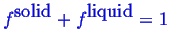
 is the fraction of the
system that is liquid and
is the fraction of the
system that is liquid and
 fraction
of system that is solid.
fraction
of system that is solid.
This corresponds to a diagram that maps stable compositions of phase
mixtures:
Figure:
Construction of the equilibrium values of the compositions
resulting from the lowest free energy in Figure .
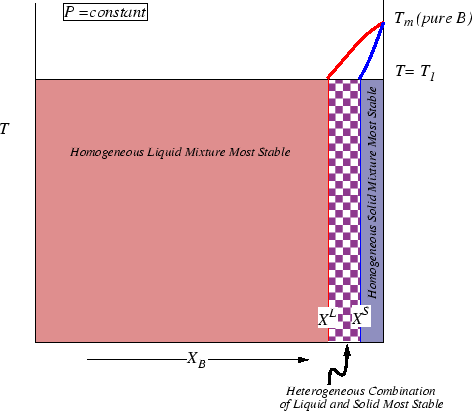 |
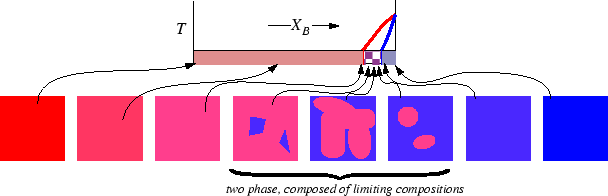
Figure 29-2:
Illustration of the physical composition of the states
corresponding to the average compositions indicated in Figure 29-1.
 |
There is a range of ``average
compositions'' at
 in which the
system has as its most stable form a
mixture of liquid at composition
in which the
system has as its most stable form a
mixture of liquid at composition
 and solid at composition
 . The
fractions of
and
come from
the requirements that the average
composition is given by:
. The
fractions of
and
come from
the requirements that the average
composition is given by:
 |
(29-1) |
or, for the general case where the two phases in
equilibrium are
 and
and
 :
:
 |
(29-2) |
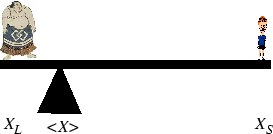
Equation 29-2 is called the lever rule:
Figure 29-3:
The lever rule as indicated by Equation 29-2--on the balance
chubby kids get the short end of the stick.
 |
Next: A Menagerie of Pure
Up: Lecture_29_web
Previous: Lecture_29_web
W. Craig Carter
2002-12-03