next up previous
Next: About this document ... Up: Lecture_23_web Previous: Some Implications of Mathematics

Further Considerations of Equilibrium

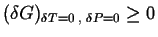
Recall the Gibbsian statements of equilibrium
$\displaystyle \input{equations/17-1A}$ (23-3)

``For equilibrium, any virtual change of the system at constant $ P$ and $ T$ must lead to an increase in the Gibbs free energy of the system.''

In other words, the Gibbs free energy must be a minimum:

$\displaystyle \input{equations/17-1B}$ (23-4)

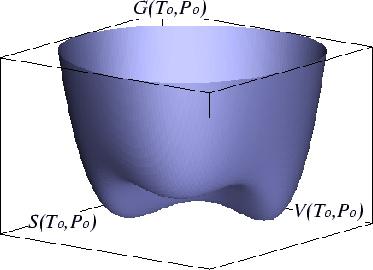
Figure 23-2: Characterizing the extrema.
\begin{figure}\resizebox{6in}{!}
{\epsfig{file=figures/G-surf.eps}}
\end{figure}


This is easier to see if we collect all the dependent variables in one coordinate:
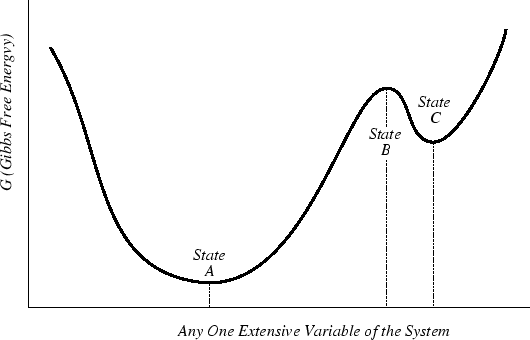
Figure 23-3: One dimensional representation of a free energy curve, what conditions must apply for equilibrium?
\begin{figure}\resizebox{6in}{!}
{\epsfig{file=figures/local-minima.eps}}
\end{figure}


Considering the local behavior of \bgroup\color{blue}$ G$\egroup:

$\displaystyle \input{equations/17-2A}$ (23-5)


The extrema can be characterized:

The points \bgroup\color{blue}$ A$\egroup and \bgroup\color{blue}$ C$\egroup are in local equilibrium.

\bgroup\color{blue}$ B$\egroup is an unstable equilibrium.

\bgroup\color{blue}$ A$\egroup is an absolute equilibrium.

\bgroup\color{blue}$ C$\egroup is a local metastable equilibrium.

Question: What if the extensive variable is held fixed in state \bgroup\color{blue}$ B$\egroup in Fig. 23-3.


next up previous
Next: About this document ... Up: Lecture_23_web Previous: Some Implications of Mathematics
W. Craig Carter 2002-11-07