


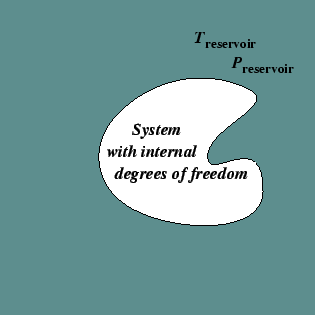
Consider that a system with internal
degrees of freedom placed inside a giant
reservoir at constant
 and
and
 (i.e.
the atmosphere or the conditions inside a
furnace, etc.) (
(i.e.
the atmosphere or the conditions inside a
furnace, etc.) (
 for reference or reservoir)
 |
We have already shown that for equilibrium:
 and
and
 for a system that can exchange energy and volume with its environment.
The condition that a spontaneous change can take place is (in other words, the system is not in equilibrium):
 |
(19-3) |
Apply the first law to the entire system:
 |
(19-4) |
so that:
 |
(19-5) |
or
 |
(19-6) |
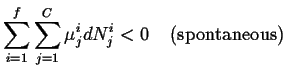
or, comparing with Equation 19-1,
 |
(19-7) |
Note that the sum in Equation 19-7 is really a placeholder for the
``internal degrees of freedom'' for a system in equilibrium with a reservoir
of constant
 and
and
 .
Equation 19-7 as it is written, with chemical potentials and changes
in the compositions, is the ``normal case'' and the one that is the best
to remember.
.
Equation 19-7 as it is written, with chemical potentials and changes
in the compositions, is the ``normal case'' and the one that is the best
to remember.