


For the case of an ideal fluid
that has ``internal
degrees of freedom,'' new terms must be added
to the internal energy. To illustrate this,
we considered that particular case
numbers of molecules of
each type (of a possible number of
 types)
was variable in each of the
types)
was variable in each of the
 possible phases.
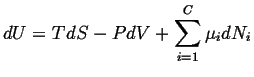 |
(19-1) |
or in general
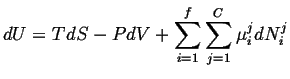 |
(19-2) |
The condition that we applied to find the
conditions of equilibrium
[(
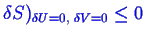 ,
or, equivalently (
,
or, equivalently (
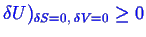 ]
previously were not practical.
It is difficult to arrange to do
experiments where
]
previously were not practical.
It is difficult to arrange to do
experiments where
 constant and
 constant.
They are difficult to arrange in the lab.
constant.
They are difficult to arrange in the lab.
Question: Consider that you are doing an experiment to determine the equilibrium properties of a material? What kinds of experimental conditions would be the most straightforward to implement?