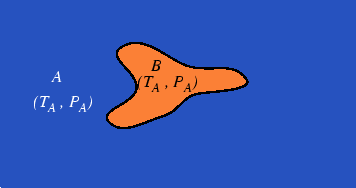
Consider an isolated system with two separate regions at uniform (but potentially different) pressures and temperatures.
Suppose that there is a ``virtual''
change (i.e. any one of an infinite number of possible changes)
in the system such
that
 and
and
 .
.
Any change in
 (
(
 ,
,
 ) can be chosen as a virtual changes as long as
we also pick for system
) can be chosen as a virtual changes as long as
we also pick for system
 ,
(
,
(
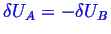 and
and
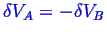 ).
).
Then
 |
(17-4) |
Because
 is independent of
we can find a
is independent of
we can find a
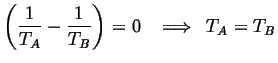
 unless
 |
(17-5) |
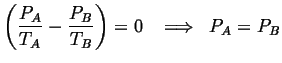 |
(17-6) |
These are the necessary conditions for equilibrium in a heterogeneous
isolated system: no spatial variation pressure can exist if the volume
can move from region to region (
 )
and no spatial variation in temperature can exist if energy can
flow from region to region (
)
and no spatial variation in temperature can exist if energy can
flow from region to region (
 ).1
).1
 with pressure and temperature
  and
and  enclosing a subregion
  at
at  and
and  .
.