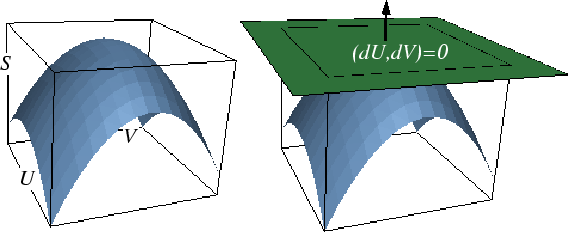
Consider a an isolated system, in this case:
 and
and

If we consider a system that can only perform
 -work on
its surroundings,
we can write for any quasi-static (constantly in equilibrium).
-work on
its surroundings,
we can write for any quasi-static (constantly in equilibrium).
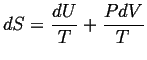 |
(17-1) |
Therefore, at equilibrium the
entropy must be a maximum or a minimum (
 ) (This is the equation of a tangent plane)
Since entropy must always increase as a system
approaches
equilibrium, it must be a maximum at equilibrium.
(In other
words, it must be at the summit of a hill
with
 given as north and
 given as
west.)
given as
west.)
How to express this maximal relationship?
Let
 represent any possible
variation (change internal temperature,
distribution, heat flow, etc.) to the
entropy. Then, if the supposed variation
also has
represent any possible
variation (change internal temperature,
distribution, heat flow, etc.) to the
entropy. Then, if the supposed variation
also has
 ,
,
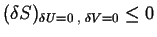 |
(17-2) |
implies
 is a maximum and is thus the
equilibrium state.
is a maximum and is thus the
equilibrium state.
This introduces the concept of a virtual change:
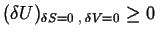
Equation 17-2 is equivalent to
 |
(17-3) |
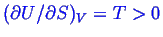
(See if you can figure out why--hint:
Implies
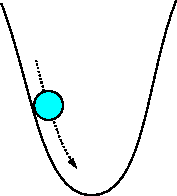
is a minimum at constant
and
--and that is what we expect from
mechanics.
 as a function of
  and
and