


 |

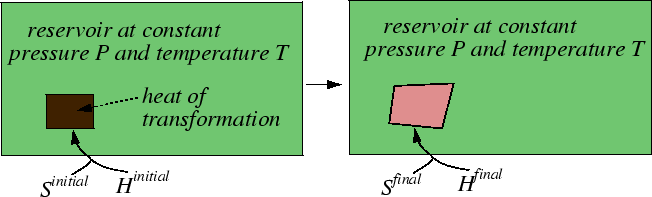
The data showed that the entropy change in the universe was positive if: 1) the high-temperature phase (liquid) converted to the low-temperature phase (ice) below the equilibrium transition (freezing) temperature; or, 2) The low-temperature phase (ice) converted to the high-temperature phase (liquid) above the equilibrium transition (melting) temperature. Furthermore, the entropy change of the universe would be negative if ice melted below the melting temperature, or if water froze above the freezing temperature.
Similar statements can be written down generally for any phase transformation:
In fact, it only happens that
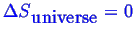 for freezing and melting at only one
temperature (at fixed pressure), and
that is:
for freezing and melting at only one
temperature (at fixed pressure), and
that is:
 K
for
H
K
for
H Oat 1 atm pressure..
In fact, at that temperature
 |
(15-1) |
Because
 was the available thermal energy at
constant
was the available thermal energy at
constant
 (recall the argument that
 was subtracting of the available compressive energy),
 |
(15-2) |
, and
 .
.
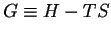
 is called the Gibbs free energy.
We can rewrite Equation 15-1 in terms of the new function:
In fact this,
will become our most favorite criteria for
equilibrium at constant
and
.
Note that there are several equivalent ways to write the Gibbs free energy in terms of the other thermodynamic functions that we have introduced.
Some of the relations for the molar Gibbs free energy are:
 |
(15-3) |
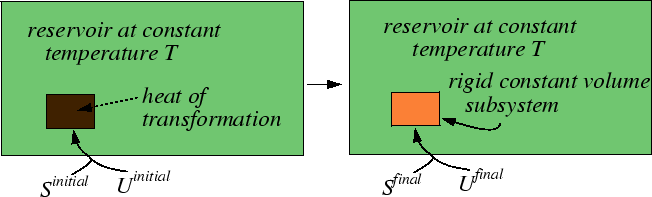
Note that if we had considered a phase change that takes place at constant volume:
 |
| Summary of Equilibrium Conditions | ||
| Change | Special Condition | Utility |
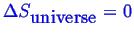 |
All cases | Fundamental criterion for reversible process or equilibrium by the second law of thermodynamics. Must be applied to every possible subsystem affected by a process. |
 |
System at constant
and
|
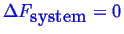
Fundamental criterion for reversible process or equilibrium for
typical experimental conditions.
Calculation need only consider the system undergoing change--but extra conditions, i.e., constant
and
must be assumed. |
 |
System at constant
 and and
|
Fundamental criterion for reversible process or equilibrium for
isothermal constant volume phase transition.
This will not differ much from
 for systems that have a small for systems that have a small
 associated with the transformation. associated with the transformation. |
 work is done so all the
the heat of transformation is provided by the
internal energy change in the material undergoing a transformation.
Application of the first and second laws results in an expression
for the entropy change in the universe:
work is done so all the
the heat of transformation is provided by the
internal energy change in the material undergoing a transformation.
Application of the first and second laws results in an expression
for the entropy change in the universe:
