


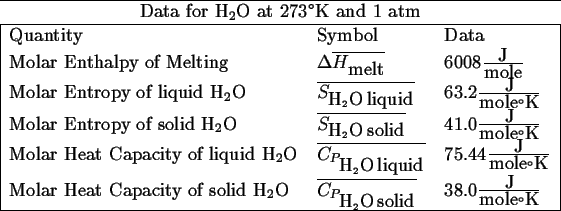
As a first approximation, ignore difference in heat capacities:
Suppose our ice-system is enclosed in a giant
reservoir at
 C (the reservoir is so big
that its temperature doesn't change, imagine cooling down the ocean with an ice-cube)
C (the reservoir is so big
that its temperature doesn't change, imagine cooling down the ocean with an ice-cube)
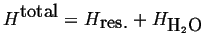 |
(14-5) |
because
 is constant and we suppose that no other heat is added to the system
from any other source (constant pressure and adiabatic system).
is constant and we suppose that no other heat is added to the system
from any other source (constant pressure and adiabatic system).
Suppose the ice melts, then
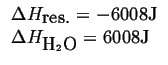 |
(14-6) |
 However,
 |
(14-7) |
The entropy of the reservoir decreases.
However the entropy change for our mole of ice that melts is:
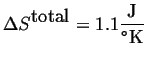 |
(14-8) |
This corresponds to what we observe, hot ice would melt and the entropy of the universe increases.
Consider the melting of cold
ice immersed in
 C reservoir:
 |
(14-9) |
Entropy of the universe decreases and this is not observed to happen--good!
Hot ice melts and cold water freezes and the entropy of the universe always increases.
 independent of temperature