means that heat was absorbed
during the transformation, as in the case of
melting (positive means that you have to add heat to make it happen).
Reactions that have a positive
are called
``endothermic.''
means that heat was absorbed
during the transformation, as in the case of
melting (positive means that you have to add heat to make it happen).
Reactions that have a positive
are called
``endothermic.''
Let's consider the reverse transformation liquid
 solid (solidification).
 |
(14-3) |
Solidification is typically ``exothermic''--when something solidifies, heat is expelled (and has to be taken away as in the case of ice in the fridge).
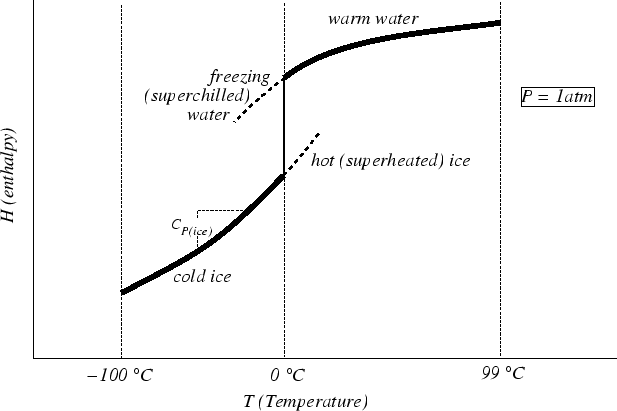
Consider a plot the enthalpy as a function of
 .
.
Question: Where the ``zero'' is located on the ordinate axis.