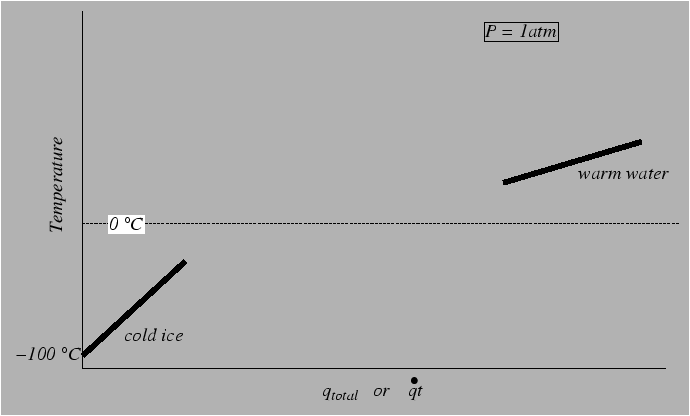
Question: What is the temperature of solid water (ice)?
 C
C
 K
K
 C
C

Consider a mole of ice at
 C that has heat added to it at a
constant rate (
C that has heat added to it at a
constant rate (
 constant) and a constant pressure.
(Slow enough so that the body has a
uniform temperature; i.e.,
reversibly at constant atmospheric pressure).
What will be the temperature as a function of
time?
constant) and a constant pressure.
(Slow enough so that the body has a
uniform temperature; i.e.,
reversibly at constant atmospheric pressure).
What will be the temperature as a function of
time?
What is the slope of the initial part of the curve (Region I)?
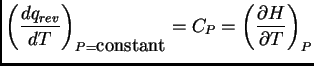 |
(14-1) |
Therefore the slope is
 :
:
Slope =

Slope =

Question: What is happening in Region II?
Question: What is the heat absorbed in Region II? Where does it go?
 |
(14-2) |
This is equivalent to the heat absorbed by the system at constant
temperature--we identified this quantity with the state
function enthalpy,
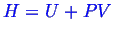 .
The change in the constant pressure heat state function
.
The change in the constant pressure heat state function
 ,
is the heat absorbed during the transformation.
,
is the heat absorbed during the transformation.