 |
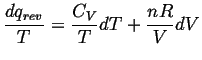
(12-1) |
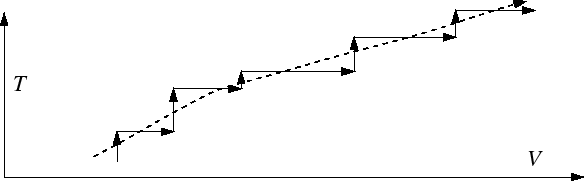
Notice that we have separated the equation
into something that is integrable over
segments of
 (holding
 constant) and
 (holding
 constant).
Therefore, over any curve that we can divide up into small orthogonal segments:
Therefore, for an ideal gas,
 is a ``perfect differential.''
The integral of
depends only on its endpoints; therefore
it has the properties of a state function.
Let's call the perfect differential in Equation 12-1
 and
and
 is defined as the new state function entropy.
 |
(12-2) |
The numerical value of entropy depends only on the state itself relative to some reference state.
Question: According to the definition in Equation 12-2, is entropy an intensive or extensive quantity?
Therefore, for an ideal gas at least,
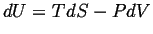 |
(12-3) |
Notice that:
is conjugate to
in the same way as
 is conjugate to
This gives a new interpretation of
: