


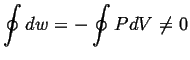
Recall that we showed that the work performed cannot be a state function because:
 |
(09-1) |
 is path dependent?
The differential work
is sometimes called ``not a perfect
differential'' because of this property.
It simply means that you need even more
information to integrate it--namely the
path:
 is ``path dependent''.
Furthermore, the idealization in Figure ![[*]](crossref.gif) is
a somewhat misleading.
is
a somewhat misleading.
It is easy to specify what the volume is in
such a system, but what about the pressure,
 ,
just after the beginning of the ``spark'' as the system expands rapidly?
The pressure is not uniform and cannot be represented for the system by
a point--so the curve cannot be represented by a series of points.
,
just after the beginning of the ``spark'' as the system expands rapidly?
The pressure is not uniform and cannot be represented for the system by
a point--so the curve cannot be represented by a series of points.
The idealization in Figure introduces the topic
of reversibility.
(Sometimes, the terms quasi-equilibrium or quasi-static are used,
they are effectively synonyms for reversible processes).
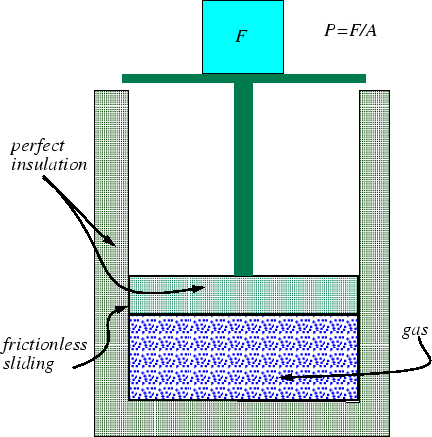
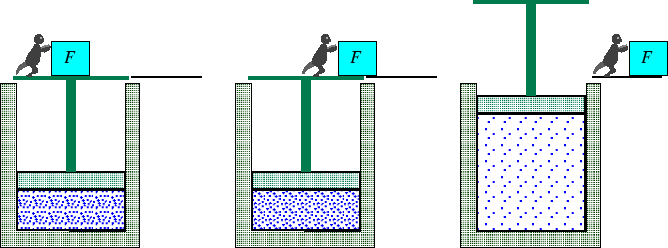
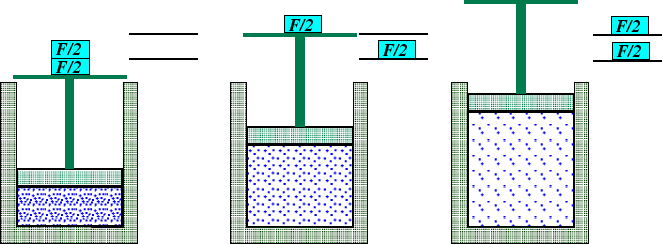
To illustrate what is meant by reversibility, consider the following simple processes:
 |
 |
 |
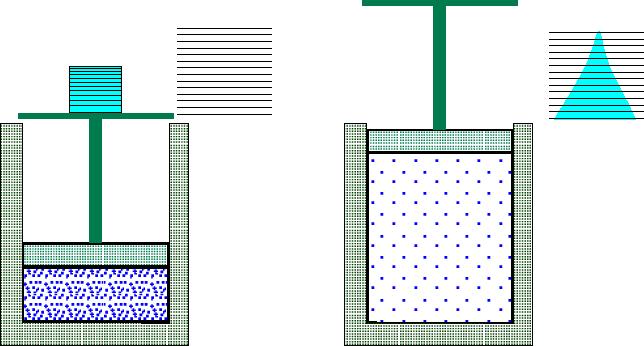 |
Question: Why is the word ``reversible'' applied to the case in Figure 9-5?
Therefore, the curves in Figure are idealizations of a sequence of equilibrium
states
 .
This idealization is called
``quasi-static'' and applies only if the
system is changing very
slowly. A quasi-static process is also
called ``reversible.''
.
This idealization is called
``quasi-static'' and applies only if the
system is changing very
slowly. A quasi-static process is also
called ``reversible.''
Because
 is a state function,
then it must be true in general that
is a state function,
then it must be true in general that
 |
(09-2) |
Because
depends on the path, so
must
 ; it is also not a perfect
differential.
; it is also not a perfect
differential.
 for a standard automobile engine.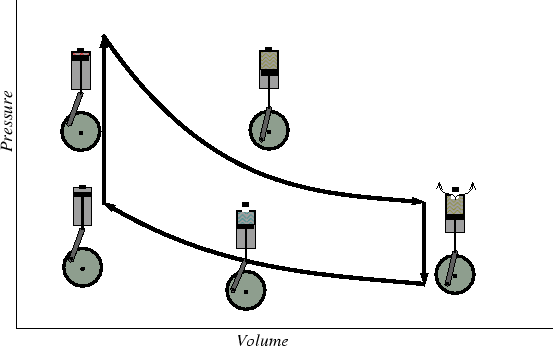
 thick,
where each
thick,
where each