next up previous
Next: About this document ... Up: Lecture_05_web Previous: Types of Processes

Composition vs Concentration

It is useful to reiterate the definitions of concentration and composition.

Concentration is the number of something per unit volume:1

$\displaystyle \mbox{Molar Concentration of Species $j$}$$\displaystyle = \frac{n_j}{\ensuremath{{V}^{\mbox{total}}}}$ (05-3)

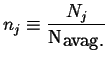
where \bgroup\color{blue}$ n_j$\egroup is the number of moles of \bgroup\color{blue}$ j$\egroup:

$\displaystyle {n_j} \equiv \frac{N_j}{\ensuremath{\mbox{N}_{\mbox{avag.}}}\newc...
...}{\ensuremath{\mbox{mole}^{-1}}} \newcommand {\mole}{\ensuremath{\mbox{mole}}}}$ (05-4)

where \bgroup\color{blue}$ N_j$\egroup is the number of \bgroup\color{blue}$ j$\egroup-type atoms or molecules.


Mole fractions or number fractions are defined by:
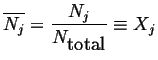
$\displaystyle \ensuremath{\overline{N_j}}= \frac{N_j}{N_{\mbox{total}}} \equiv X_j$ (05-5)

Mole fractions are unit-less--they are just numbers and each must satisfy \bgroup\color{blue}$ 0 \leq X_j \leq 1$\egroup and their sum must satisfy:

$\displaystyle 1 = \ensuremath{\sum_{j=1}^{C}}X_j$ (05-6)


Composition describes the molar chemical complexion of a system--it is the set of mole fractions: \bgroup\color{blue}$ ( X_1 , X_2 , \ldots , X_C ) = \frac{1}{N_{\mbox{total}}} ( N_1 , N_2 , \ldots , N_C )$\egroup.


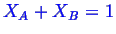
In the special case of the binary alloys (those that have only two possible components \bgroup\color{blue}$ A$\egroup and \bgroup\color{blue}$ B$\egroup), the composition can be identified with a single variable \bgroup\color{blue}$ X=X_B$\egroup because \bgroup\color{blue}$ X_A$\egroup is fixed by the relation \bgroup\color{blue}$ X_A + X_B = 1$\egroup.


next up previous
Next: About this document ... Up: Lecture_05_web Previous: Types of Processes
W. Craig Carter 2002-09-12