What is energy?
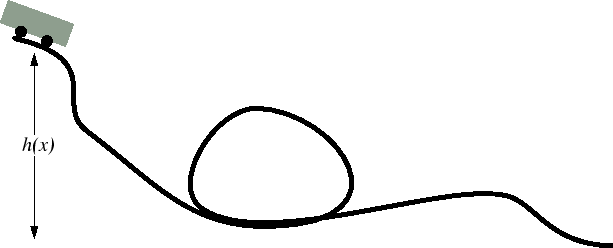
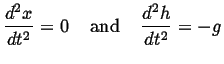
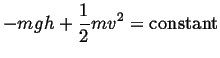
You learned in Newtonian mechanics part of physics that sum of kinetic energy and potential energy of a body was conserved to solve useful problems
 |
(01-1) |
 |
(01-2) |
You learned in later physics or chemistry that the stable state has the lowest energy.
How can both statements, ``Energy is conserved'' and ``Energy is minimized'' be true?
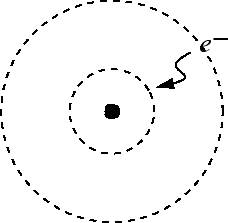
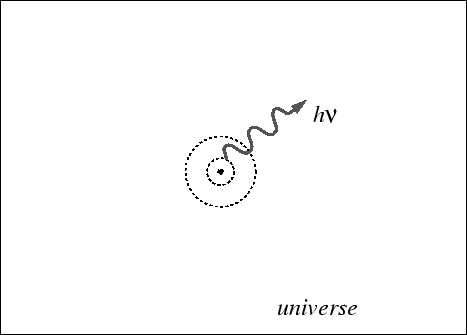
In particular consider a proton and electron:
What is temperature
Example of old battery?
What is entropy?
Does energy exist?
Physicists believe it does because a conservation principle seems to apply to each observation made by observers
Mathematicians might think of it as an abstract quantity that physicists talk about all the time and conserved quantities have useful things to prove theorems about.
Observers believe it exists because physicists tell them to look for something conserved,
Philosophers might believe it because it is aesthetically beautiful-- or would say that if we ever found an observation contrary to the expectation that energy is conserved, that physicists would make up a new type of energy to balance things out.
Here is the opinion of one famous scientist on energy:
It is important to realize the in physics today, we have no knowledge of what energy isIt is an abstract thing
R.P. Feynman
 ?
?